Radioactive Glass in Lenses

I
Some camera lenses are radioactive...
From about 1940 to the mid-1970's, some high-performance lenses contained one or more elements made from glass containing thorium. Thorium glass has the desirable property of combining high Refractive Index with low Dispersion ('Dispersion' is the measure of the degree to which the refractive index of the glass varies with wavelength, i.e. between red and blue light). The chemical element Thorium is found in granite and other rocks and is naturally radioactive. Thorium has two naturally-occurring isotopes, Thorium-232 and Thorium-230, which undergo radioactive decay, changing into Radium-228 and Radium-226, respectively. Although Thorium-230 is present as only 0.02% of natural thorium, it has a much shorter half-life than Thorium-232 and so the build up of its decay product, Radium-226, reaches a higher level. This process is called 'ingrowth' and means that lenses made with thorium glass are becoming more radioactive over time and will continue to do so until the Radium-226 reaches 'radioactive equilibrium', a few hundred years after manufacture. Radium-226 emits gamma rays (186 kilo-electronVolts, keV) that can easily be detected outside the lens, although some of the radiation is absorbed by the glass itself, other lens elements and components, and the surrounding air. The thorium glass components in the Takumar lenses measured for this project were inside the rear lens group. Therefore, the highest radiation levels are found at the lens' rear.
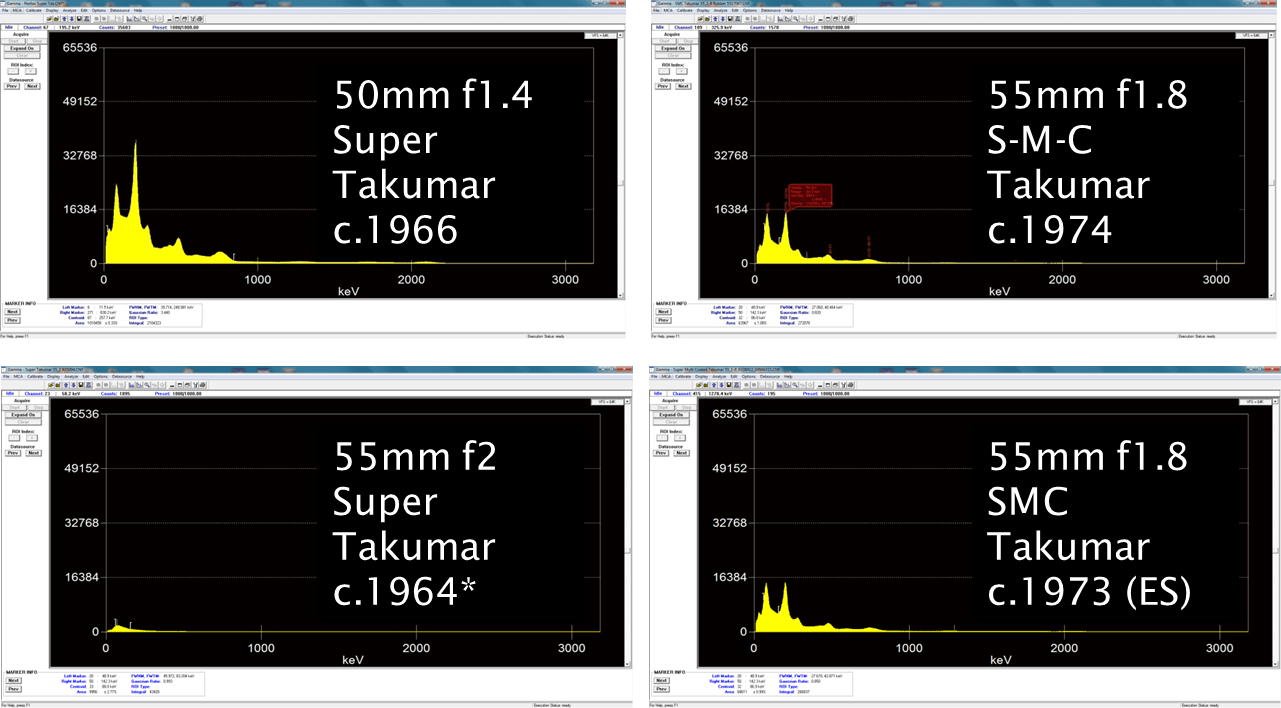
Using gamma-spectroscopy, I estimated the radioactivity due to Radium-226 of a Super-Takumar 50mm f1.4 lens, made c. 1967, to be about 1 micro Curie (uCi) / 37kiloBecquerels (kBq). For a 55mm f1.8 SMC Takumar from c. 1972, the Radium-226 activity was about 0.5uCi (18.5kBq). That is what would be expected as the f1.8 lens glass volume is about half that of the f1.4 lens.
A Super-Takumar lens from c.1964 was not radioactive (not above normal background radiation level), and nor were K-mount SMC Pentax 55mm f1.8 and 50mm f1.4 lenses from c.1975. Traces of naturally-radioactive Lanthanum-140 can be seen in the gamma-ray spectrum, suggesting the manufacturer used lanthanum as a substitute for thorium in these more recent lenses.
The optical performance of the radioactive SMC Takumar 55mm f1.8 and non-radioactive SMC Pentax (K) 55mm f1.8 appear to be identical, for all practical purposes.
The thorium-glass elements become yellow-brown over time. This can be at least partly reversed by exposing the affected lens to strong sunlight or special UV lamps. The brown tinge is noticeable through the SLR camera's viewfinder. It has the effect of a 'warm-up' filter on colour film.
The radiation exposure to photographers using these lenses is likely to be insignificant compared to our everyday exposure from natural background radiation. However, it is unwise to hold the lens close to the eye. For service technicians, it is important to handle the thorium glass elements with care to avoid breakage and injuries from glass fragments.
This work won the Philip Nicholson prize for the Best Poster at the UK Society of Radiological Protection Annual Conference, Bournemouth, 5-8 July 2021.
The Gamma-spectra shown below were measured with a 2 x 2 sodium iodide (NaI:Tl) scintillation detector positioned 25mm from the rear face of each lens. The counting time was 1000s. The vertical (y-axis) shows the total count per channel in 1000s, while the x-axis is the calibrated gamma-ray energy in keV. Dedicated software was used for energy and geometrical efficiency calibration and for identification of spectral peaks, reporting of radio-isotopes present in the spectrum, and estimation of the amount (the activity) of each radio-isotope.